Michael Pollan’s 7 Rules for Eating
Seven words, seven rules, and a much simpler way to think about food.
Food Rules: An Eater’s Manual
Michael Pollan · the little book these rules come from
Get the book on AmazonFor more than thirty years Michael Pollan has been writing about the place where nature and culture meet: on our plates, in our gardens and farms, and in our communities. He wrote The Omnivore’s Dilemma, In Defense of Food and Food Rules, and I keep coming back to him because he makes eating well simple again.
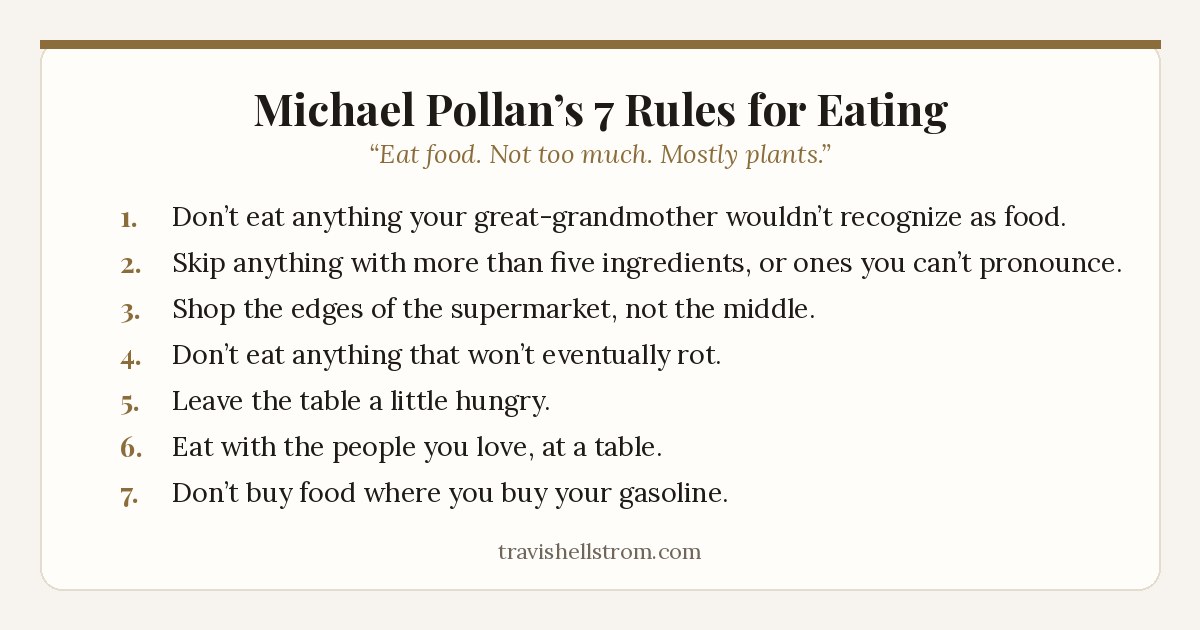
He says everything he has learned about food fits in seven words:
“Eat food. Not too much. Mostly plants.”
The first two words carry most of the weight. Eat food means real food: vegetables, fruit, whole grains, and yes, fish and meat, and not what Pollan calls “edible food-like substances.” Here are the seven rules he uses to tell the difference, in my words, with why I think each one works.
- 1. Great-grandmother
- 2. Five ingredients
- 3. The edges
- 4. Rot
- 5. A little hungry
- 6. People you love
- 7. Not at the gas station
Rule 1Don’t eat anything your great-grandmother wouldn’t recognize as food.
Pick up a tube of portable yogurt, or a box with fifteen ingredients on the side, and ask what all of that is doing there. If she would have been puzzled by it, it is probably not food. It is something made to look like food.
Rule 2Skip anything with more than five ingredients, or ingredients you can’t pronounce.
A long ingredient list means a factory made it. A short list, in words you know, means a kitchen could have. This one rule quietly removes most of the middle of the grocery store.
Rule 3Shop the edges of the supermarket, not the middle.
Real food lives around the perimeter, near the loading docks, where it can be replaced with fresh food when it goes bad. The middle aisles hold the things that never go bad, which is exactly the problem.
Rule 4Don’t eat anything that won’t eventually rot.
There are exceptions, honey being the famous one, but as a rule a food that can sit on a shelf for years is not really food. Things that are alive, or were recently, spoil. That is a feature.
Rule 5Leave the table a little hungry.
How you eat matters as much as what you eat. Many cultures have a rule for stopping before you are full: in Japan they say to eat until you are four-fifths full, and the Germans say to tie off the sack before it is full. It takes a while for the body to notice it has had enough. Give it the while.
Rule 6Eat with the people you love.
At a table, at regular times, and not in front of a screen. Families used to do this without thinking about it. A meal is more than fuel; it is one of the few times a day everyone is in the same place, facing each other.
Rule 7Don’t buy food where you buy your gasoline.
Gas stations sell a lot of things, and almost none of them are food. The same goes for the places built for convenience rather than eating. If a place exists to sell you fuel, let it fuel the car.
Why these rules work
None of them counts a calorie or names a nutrient. That is the point. Pollan’s argument in In Defense of Food is that the more we have talked about nutrients, the worse we have eaten. Rules like these work because they are about attention and habit: what goes in the cart, who is at the table, when to stop. I first wrote this up in 2014 for Advance Humanity, the company I ran then, because so much of doing good work comes down to simple, repeatable habits, and eating is the one we practice three times a day.
Go deeper
Food RulesSixty-four rules, one page each. The source of these seven.
 In Defense of FoodThe argument behind the seven words.
 The Omnivore’s DilemmaWhere our food actually comes from.
- Michael Pollan’s website, with his articles and talks
- Michael Pollan on Wikipedia
- More of my past writing and book reviews