The 7 Habits of Highly Effective People: A Summary
One of my all-time favorite books — all seven of Stephen Covey’s habits, first as a list, then one by one.
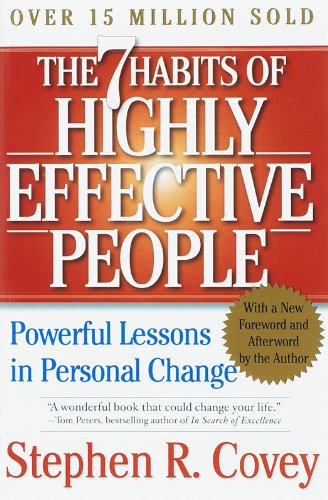
The 7 Habits of Highly Effective People
Stephen R. Covey · Powerful Lessons in Personal Change · first published 1989
Get the book on AmazonThe 7 Habits of Highly Effective People is one of my favorite books, and one I’ve been coming back to for twenty years. I was already writing about how fond I was of it back in 2006, and its lessons keep showing up in my own work, from how I try to listen to the renewal week in my Crafting Your Purpose course.
Covey’s big idea is that lasting effectiveness works from the inside out. Quick-fix techniques don’t hold up; character does. So the habits build on each other: the first three move you from dependence to independence (Covey calls them the private victory), the next three move you from independence to interdependence (the public victory), and the seventh keeps all of it renewed.
The 7 Habits at a Glance
The Private Victory
The Public Victory
Renewal
The 7 Habits, Explained
The Private Victory
- Be proactive. Between what happens to you and how you respond, there is a space, and in that space is your freedom to choose. Proactive people take responsibility for their responses instead of blaming conditions or other people. Covey draws two circles: a big Circle of Concern (everything you worry about) and a smaller Circle of Influence (the things you can actually do something about). Proactive people spend their energy on the second one, and it grows.
- Begin with the end in mind. All things are created twice: first in the mind, then in reality. Covey asks you to imagine your own funeral and what you’d hope the people who loved you would say. Then write a personal mission statement built on those values and principles, and use it as the measure for everything else.
- Put first things first. Habit 2 decides what matters; Habit 3 is the discipline of acting on it. Covey’s time management matrix sorts everything by urgent and important, and the quadrant that changes lives is Quadrant II: important but not urgent — planning, relationships, health, prevention. Plan your week around your roles and goals, and schedule your priorities instead of prioritizing your schedule.
The Public Victory
- Think win-win. Most of life isn’t a competition. Win-win means looking for agreements that benefit everyone, and it comes from an abundance mentality: the belief that there’s plenty out there for everybody. If no deal works for both sides, the best answer is “no deal.” Behind it all is Covey’s Emotional Bank Account — the trust you build with kindness, keeping promises and apologizing sincerely.
- Seek first to understand, then to be understood. Most people listen with the intent to reply. Covey asks for empathic listening: listening to understand the other person’s frame of reference, feelings and all, before you prescribe anything. Diagnose before you prescribe. Once people feel truly understood, they’re far more open to understanding you.
- Synergize. When people who trust each other bring their differences together, the whole becomes greater than the sum of its parts. Value the differences instead of merely tolerating them, and look past “my way or your way” for a third alternative better than what either person walked in with.
Renewal
- Sharpen the saw. The woodcutter who’s too busy sawing to stop and sharpen his saw works harder and gets less done. Habit 7 is regular renewal in four dimensions: physical (exercise, rest, nutrition), spiritual (values, reflection, nature, meditation), mental (reading, learning, writing) and social/emotional (service, empathy, relationships). It’s the habit that makes the other six possible.
If you only try one thing, try Habit 2: sit down with a blank page and write what you’d want said about you at the end. It’s the same question behind my free Values Exercise.
Resources
- The 7 Habits of Highly Effective People on Amazon
- The 7 Habits at FranklinCovey
- Stephen R. Covey on Wikipedia
- How to Win Friends and Influence People, the other classic I’ve summarized
- More of my book summaries and reviews on Resources