Steal Like an Artist: The 10 Rules, Summarized
Austin Kleon’s little black book on creativity — all ten of his “things nobody told you,” first as a list, then one by one.
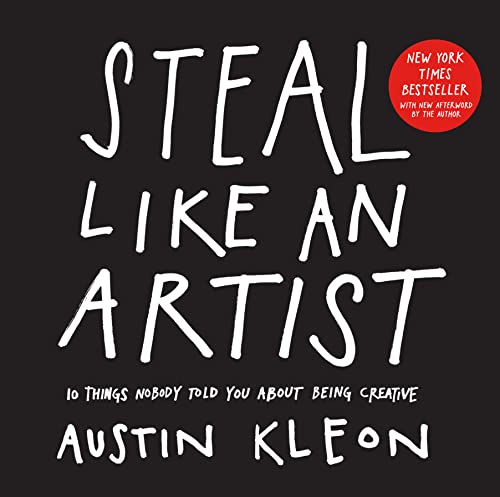
Steal Like an Artist
Austin Kleon · 10 Things Nobody Told You About Being Creative · Workman, 2012
Get the book on AmazonSteal Like an Artist is Austin Kleon’s short, hand-lettered, black-and-white manifesto for anyone who makes things. It started as a talk he gave to college students, became a New York Times bestseller, and reads in about an hour — which makes it an easy book to keep coming back to.
Its big idea is freeing: nothing is completely original, so stop waiting for an original idea and start collecting, copying, remixing and sharing. Kleon makes the case with a line from Mark Twain that I’ve now added to my Mark Twain quote library:
“It is better to take what does not belong to you than to let it lie around neglected.”
— Mark Twain
Here are the ten rules, first as a quick list and then with what each one means.
The Quick Summary
- Steal like an artist.
- Don’t wait until you know who you are to get started.
- Write the book you want to read.
- Use your hands.
- Side projects and hobbies are important.
- The secret: do good work and share it with people.
- Geography is no longer our master.
- Be nice. (The world is a small town.)
- Be boring. (It’s the only way to get work done.)
- Creativity is subtraction.
The Ten Rules, Explained
- Steal like an artist. Nothing is completely original. Every new idea is a mashup or remix of older ones, so the question isn’t whether to steal but how. Kleon draws the line between good theft and bad theft: honor, study, steal from many, credit, transform and remix — never degrade, skim, steal from one, plagiarize or rip off. Collect what inspires you (he calls it a swipe file), carry a notebook, and climb your own family tree: pick one thinker you love, learn everything about them, then find the three people they loved and do the same.
- Don’t wait until you know who you are to get started. You find out who you are by making things, not the other way around. Start by copying your heroes, the way musicians learn scales and painters copy the masters — copy to learn, not to pass it off as yours. And don’t just imitate the look of their work; figure out the thinking behind it, so you can emulate it and turn it into something of your own.
- Write the book you want to read. Forget “write what you know.” Write what you like. Think of the work you wish existed — the sequel your favorite artist never made, the band you wish you could hear — and make that.
- Use your hands. Step away from the screen. Creativity comes from the body as well as the head, and a computer is better at editing ideas than at having them. Kleon keeps two desks: an analog one for scribbling and cutting things up, and a digital one for finishing and publishing.
- Side projects and hobbies are important. The things you do “on the side” are often where the real work happens. Practice productive procrastination: bounce between projects, let yourself be bored, and don’t throw any part of yourself away. The hobby that seems unrelated may be the thing that makes your work yours.
- Geography is no longer our master. You don’t have to live in a creative capital to do creative work. Build your own world wherever you are — fill your space with the books and objects that inspire you, find your people online, and leave home now and then, because new places give your brain new material.
- Be nice. (The world is a small town.) Make friends, ignore enemies, and stand next to people more talented than you. The best way to get attention is to pay it to others. Don’t waste energy picking fights, write public fan letters to people you admire, and keep a file of the kind words people send you for the hard days.
- Be boring. (It’s the only way to get work done.) The steady life makes room for the wild work. Take care of yourself, stay out of debt, keep your day job, keep a calendar and a logbook, and choose your partner well. Routine isn’t the enemy of creativity; it’s what protects it.
- Creativity is subtraction. In a world of endless options, deciding what to leave out is the creative act. Embrace limits: a tight deadline, a small budget or a narrow brief forces you to use what you have and get to work.
Resources
- Steal Like an Artist on Amazon
- Austin Kleon on the book (austinkleon.com)
- Over 230 Mark Twain quotes in my Quote Library
- More of my book summaries and reviews on Resources