Abundance: A Summary of Why the Future Is Better Than You Think
Peter Diamandis and Steven Kotler’s case for optimism — the problem with our brains, the pyramid of abundance and the four forces building it.
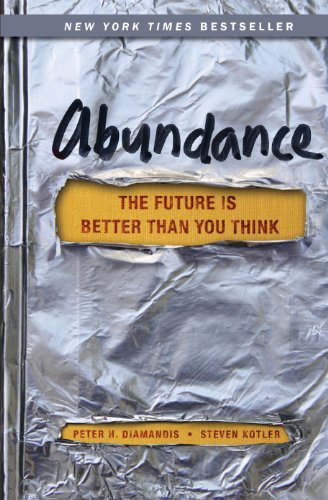
Abundance
Peter H. Diamandis & Steven Kotler · The Future Is Better Than You Think · Free Press, 2012
Get the book on AmazonI read Abundance within a year of its release, and Bold within a year of its. Peter Diamandis is a positive and optimistic guy, which I appreciate. He also brings research, great history and stories to back up his positions. It’s refreshing and helpful in a world that can often feel overwhelming and confusing.
Abundance is a book-length argument for optimism, backed by data. Peter Diamandis and Steven Kotler argue that technology is on track to meet the basic needs of every person on the planet — clean water, food, energy, education, health care — and that we tend not to see it because our brains are wired to notice what’s going wrong.
Their opening story makes the point. In the 1800s aluminum was more precious than gold; Napoleon III is said to have served his most honored guests with aluminum cutlery while everyone else ate off gold. Then chemists found a cheap way to separate it from the earth, and today we wrap sandwiches in it. Scarcity, they argue, is often about access, and technology is a resource-liberating force.
The Quick Summary
Why we miss the good news
What abundance means
The four forces of abundance
Abundance, Explained
Why we miss the good news
- Our brains are built to look for danger. The amygdala scans constantly for threats, and the news gives it plenty — “if it bleeds, it leads.” So we badly underestimate how much better the world is getting, in lifespans, poverty, literacy and violence.
- We think locally and linearly. We evolved in a world where tomorrow looked like today. Exponential change — a technology that doubles in power every year or two — is almost impossible for us to picture, so we miss what’s coming.
What abundance means
- The pyramid of abundance. Modeled loosely on Maslow’s hierarchy, it starts with the basics at the bottom — water, food and shelter — then the catalysts for growth — energy, education, and information and communication — and at the top, health and freedom. The goal isn’t luxury for everyone; it’s raising the floor so every person has what they need.
The four forces of abundance
- Exponential technology. Computing, networks and sensors, artificial intelligence, robotics, digital manufacturing, medicine and nanotechnology are all getting dramatically cheaper and more powerful at once, and they’re being aimed at water purification, farming, solar energy and health care.
- The DIY innovator. Small teams and garage tinkerers can now do what once took governments and giant corporations, from building spaceships to reading genomes.
- The techno-philanthropist. A new generation of tech billionaires — people like Bill Gates, Pierre Omidyar and Jeff Skoll — is putting its fortunes and its problem-solving style into global challenges.
- The rising billion. The poorest people on earth are coming online through cheap phones and the internet. As they gain access to information, markets and education, they become inventors and customers, not just recipients of aid.
It’s a hopeful book, and a fitting one for a newsletter about optimism. The follow-up, Bold, is the how-to for entrepreneurs who want to help build that future.
Resources
- Abundance on Amazon
- Abundance at diamandis.com
- Peter Diamandis: Abundance is our future (TED, 2012)
- The follow-up: Bold, summarized
- More of my book summaries and reviews on Resources