Bold: A Summary of How to Go Big
Peter Diamandis and Steven Kotler’s playbook for thinking big — the technology, the mindset and the crowd.
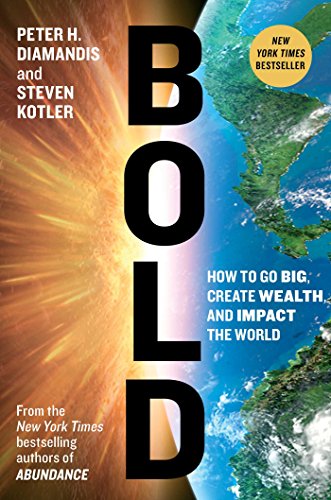
Bold
Peter H. Diamandis & Steven Kotler · How to Go Big, Create Wealth and Impact the World · Simon & Schuster, 2015
Get the book on AmazonI read Bold within a year of its release, just as I had Abundance a few years before. Peter Diamandis is a positive and optimistic guy, which I appreciate. He also brings research, great history and stories to back up his positions. It’s refreshing and helpful in a world that can often feel overwhelming and confusing.
Bold is the sequel to Abundance. Where Abundance argues that the future is better than you think, Bold is the how-to: a guide for entrepreneurs who want to use exponential technology to take on the world’s biggest problems. Peter Diamandis founded the XPRIZE and co-founded Singularity University, and Steven Kotler is a journalist who writes about peak performance; together they make the case that a small team can now do what only governments and giant companies could do a generation ago.
The book comes in three parts: bold technology, a bold mindset and the bold crowd.
The Quick Summary
Part One: Bold Technology
Part Two: The Bold Mindset
Part Three: The Bold Crowd
Bold, Explained
Part One: Bold Technology
- Learn the 6 Ds of exponentials. Once a technology goes digitized, it follows a chain reaction: deceptive (early doublings look like nothing), disruptive (then it upends an existing market), dematerialize (whole products disappear into a phone), demonetize (the cost falls toward zero) and democratize (it ends up in everyone’s hands). The cautionary tale is Kodak, which invented the digital camera and was then bankrupted by it.
- Think exponentially, not linearly. Our brains evolved to predict a linear world; 30 steps take you 30 paces, but 30 doublings take you around the world many times over. The authors tour the technologies on that curve — networks and sensors, infinite computing, artificial intelligence, robotics, 3D printing and synthetic biology — and argue that the opportunities are biggest for those who see the curve early.
Part Two: The Bold Mindset
- Build a skunk works. Big ideas need protected space. Borrowing from Lockheed’s legendary Skunk Works, the authors recommend small, isolated teams that are allowed to take big risks and fail fast, free from the rest of the organization’s rules.
- Go big: think at scale. Drawing on Larry Page, Elon Musk, Richard Branson and Jeff Bezos, the book argues that a ten-times goal is often not much harder than a ten-percent one, because it forces you to start over instead of tinkering. Pick a purpose big enough to be worth the risk, and let it drive you.
- Solve the world’s biggest problems. Diamandis’s signature idea: the world’s biggest problems are also its biggest business opportunities. Help a billion people and the business will follow.
Part Three: The Bold Crowd
- Crowdsource. Anyone with an internet connection can now tap a global pool of talent for design, coding, data and ideas, faster and cheaper than hiring.
- Crowdfund. Platforms like Kickstarter let you test demand and raise money at the same time. The authors walk through what makes a campaign work, from a clear story to the rewards and the community behind it.
- Build communities. A community gathered around a shared purpose is a lasting advantage. Give people a reason to belong and a way to contribute.
- Use incentive competitions. The Ansari XPRIZE offered $10 million for the first private spaceship to reach space twice in two weeks; it was won in 2004, and the teams spent many times the prize money trying. A well-designed prize pulls in innovators from everywhere and pays only for success.
Resources
- Bold on Amazon
- Bold at diamandis.com
- XPRIZE
- The book that came first: Abundance, summarized
- More of my book summaries and reviews on Resources